Skip to content
Hero Background Light

Leibniz Calculus Beauty of Mathematics

A modern, free platform for learning mathematics

Who is for Leibniz Calculus

Self-Learners

Study mathematical theory systematically from the ground up in a modern format. The material is structured to guide you from basic concepts to complex ideas


School Students

Review theory and solve non-trivial problems that go beyond the standard school curriculum. Don’t just apply formulas - understand how and why they work

Tutors

Stop wasting time searching for problems across hundreds of textbooks and manuals. Quickly find interesting and challenging problem sets tailored to a specific student’s level

Parents

Refresh topics you’ve forgotten since school or university and help your child truly understand mathematics. Explain the logic behind the solution, rather than just checking answers against a key

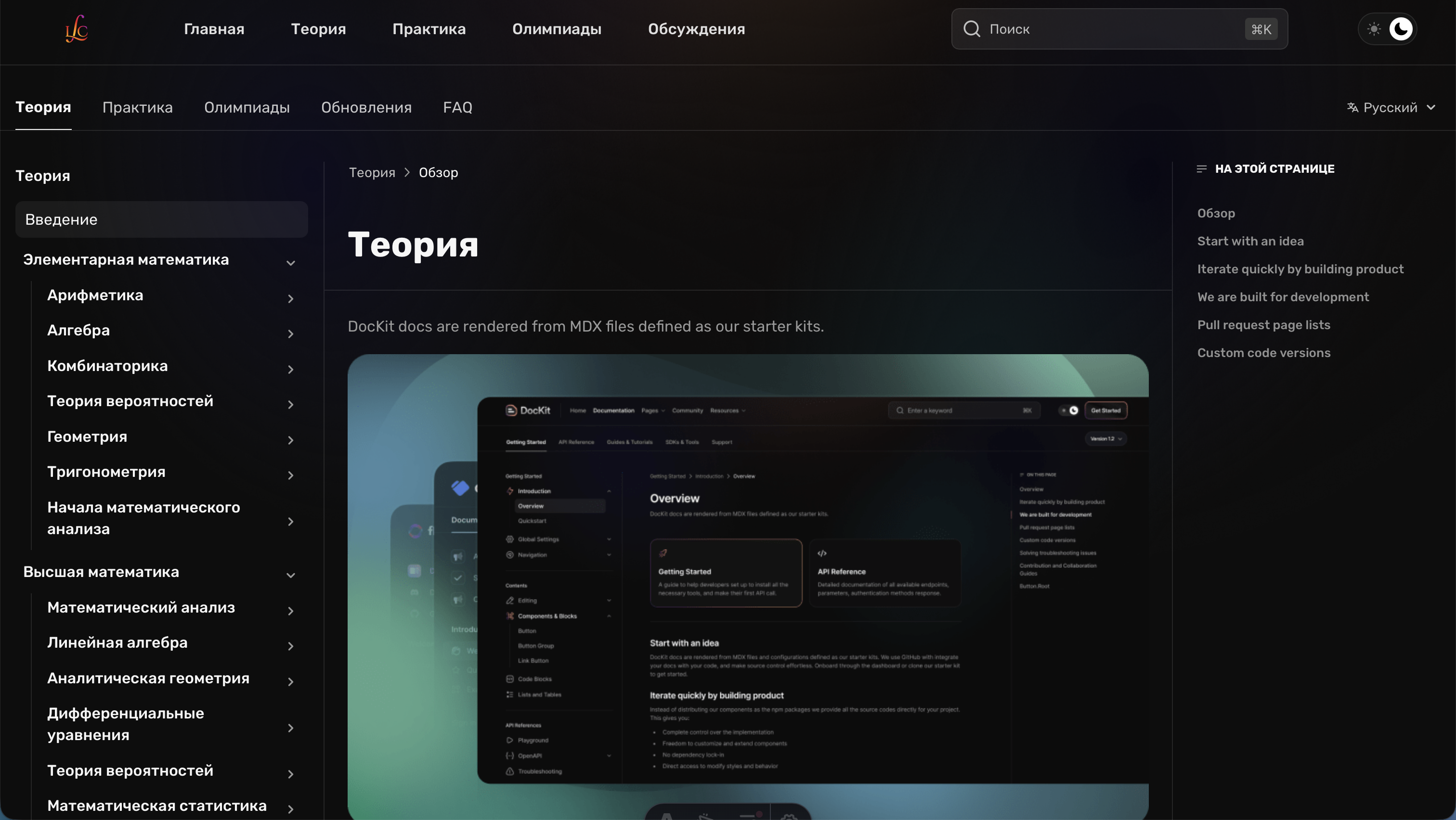
The Learning Path

Core branches ofElementary Mathematics

Algebra

Algebra

25 Articles
  • Exponents
  • Roots
  • Inequalities
  • Equations
  • Systems of equations
  • Functions and their graphs

View all topics

Algebra
Geometry

Geometry

28 Articles
  • Angles
  • Circles
  • Geometric shapes
  • Triangles
  • Quadrilaterals
  • Solid geometry

View all topics

Geometry
Trigonometry

Trigonometry

22 Articles
  • Degrees and radians
  • The unit circle
  • Trigonometric identities
  • Reduction formulas
  • Trigonometric inequalities
  • Trigonometric equations

View all topics

Core branches ofAdvanced Mathematics

Mathematical Analysis

Mathematical Analysis

25 Articles
  • Limits of sequences and functions
  • Differential calculus
  • Integral calculus
  • Multivariable functions
  • Numerical and functional series
  • Vector analysis
  • Measure theory and the Lebesgue integral
  • Calculus of variations
  • Line and surface integrals

View all topics

Mathematical Analysis
Linear Algebra

Linear Algebra

26 Articles
  • Matrices and matrix operations
  • Determinants
  • Vector spaces
  • Linear mappings (operators)
  • Eigenvalues and eigenvectors
  • Euclidean spaces and orthogonality
View all topics
Analytic Geometry

Analytic Geometry

20 Articles
  • Coordinate systems
  • Vector algebra
  • Lines in a plane
  • Planes and lines in space
  • Conic sections
  • Quadric surfaces
View all topics
Discrete Mathematics

Discrete Mathematics

31 Articles
  • Number theory
  • Set theory
  • Graph theory
  • Theory of relations and functions
  • Automata theory and formal languages
  • Theory of computation and computational complexity

View all topics

Probability Theory

Probability Theory

22 Articles
  • Random events
  • Repeated independent trials
  • Discrete random variables
  • Continuous random variables
  • Systems of random variables and bivariate distributions
  • Limit theorems in probability theory

View all topics

Still have questions? We've answered them below

About the platform

Who it is for

Learning process

How to study

Olympiad mathematics

About olympiads

Who is this platform for?

The platform was developed for self-learners who want a systematic understanding of mathematics and to solve non-trivial problems, for school students preparing for olympiads, and for university students who want to truly understand math and develop mathematical thinking.

Is it free?

The platform is absolutely free and always will be.

Why should you give it a try?

We don't just rehash textbooks; we curate theory from the best Soviet, Russian, and international sources, and select medium- and high-difficulty problems - including olympiad problems that are hard to find in the public domain. We pay special attention to visualization, turning abstract mathematical concepts into clear, tangible images.

How long does it take to learn?

There are no deadlines - the platform functions as a database of theory and problems that you navigate at your own pace. Some people master a topic in a day, while others spend weeks working through it, gradually moving on to increasingly difficult problems.

How should I study?

We recommend first studying the theory for a topic, testing your understanding in practice, and then moving on to increasingly complex problems. Don't skip medium-difficulty problems even if the topic seems clear: they reinforce crucial aspects and fill knowledge gaps that might surface when tackling harder problems.

Can I just solve problems without reading the theory?

Yes, you can, if you are already familiar with the topic and just need practice. If you encounter difficulties, refer back to the theory: advanced problems often require precise knowledge of definitions and methods.

Why should I solve olympiad problems?

Olympiad problems develop out-of-the-box thinking that standard school problems don't train. These are the exact skills that will help you tackle rigorous university coursework and any situation where there isn't a ready-made algorithmic solution.

Which olympiads are covered?

The resource features problems and detailed solutions from major university, All-Russian, American, and international mathematical olympiads.

Who can I ask for help with a difficult problem?

You can discuss problem-solving methods and algorithms in our Telegram chat.